


PhD in Counselor Education and Supervision
Study Advanced Counseling Education Concepts
The Doctor of Philosophy (PhD) in Counselor Education and Supervision program at Grand Canyon University offers you the theoretical and practical background knowledge necessary to teach counseling students and supervise clinical counselors. Before earning a doctorate in counselor education and supervision, you must conduct original research to develop and test new ideas and theories. This research can potentially position you to become a practitioner who is capable of supporting counseling students and clinical counselors.

Online: $760 per credit [More Info]
Up to 9 doctoral credits
Credits: Fill out the Lopes Eval to find out what will transfer

Benefits of GCU's Counselor Education and Supervision PhD
Doctoral students pursuing GCU’s PhD with a qualitative focus will conduct research that focuses on describing how and why people think, believe and behave a certain way. Students pursuing GCU’s PhD with a quantitative focus will analyze original concepts by interpreting numeric data. To complete the data analysis for a PhD in Counselor Education and Supervision, you will create a sampling plan, design various research tools, collect data and analyze the data using a systematic approach. Your results and analysis will then be presented in a written dissertation.
Pursue a PhD in Counselor Education and Supervision Online
GCU’s PhD in Counselor Education and Supervision is offered online, which gives you the flexibility and convenience to work and complete your doctoral degree at the same time. In addition to our interactive digital learning platform, you can benefit from GCU’s other online resources, such as the Doctoral Community (DC) Network,(See disclaimer TM) which facilitates scholarly connections and collaboration.
In addition to your online coursework, you will attend in-person residencies where you will have access to doctoral faculty and peer feedback for your proposed dissertation research. GCU’s PhD in Counselor Education and Supervision online program is designed to be interactive with your peers and your program leadership through open, collaborative forums.
Skills and Coursework Taught in This PhD in Counselor Education Program
On the path to supporting other counselors, you may examine how to improve your own practice and impact the health outcomes of your clients. Through coursework and research, residency, internship and program requirements, you may have the opportunity to demonstrate your professional growth. The combination of theoretical and hands-on work may help you prepare yourself for potential transition into the next stages of your career.
The College of Humanities and Social Sciences has outlined the six domains that highlight the goals of the PhD in Counselor Education and Supervision coursework.
Counseling
Examine and integrate ethical and culturally relevant theories of counseling
Supervision
Develop a legal, ethical and personally relevant style of clinical supervision
Teaching
Design, deliver and evaluate counselor education experiences
Scholarship and Research
Conduct independent research
Leadership and Advocacy
Lead and advocate based on prevailing social, cultural and political conditions and trends within counseling
Special Topics
Evaluate the integration of evidence-based treatments relevant to family systems and group dynamics and processes
Work on Your Dissertation Throughout the Program
When you earn your doctorate at GCU, you will begin to work toward your dissertation throughout your program by working with a mentor, completing coursework, and completing residencies focused on the development of your original dissertation research.
Program Dissertation Requirements
You will complete a required dissertation that will conclude this program. You will begin to develop elements of your dissertation from the start of the program by expanding your idea for your original research project and concluding with conducting the research and analyzing your findings in dissertation courses with the guidance of your dissertation committee. Along the way, you’ll take courses in research and counselor education and supervision that prepare you for your dissertation defense by teaching analytical and communication skills. In addition, you must complete two in-person residencies and required internships to meet all graduation requirements.

Career Paths for PhD in Counselor Education and Supervision Degree Holders
As a graduate of the PhD in Counselor Education and Supervision program, you may oversee clinical counselors and provide instruction and leadership when necessary.
No degree program can guarantee any specific career outcome. However, after earning your PhD, you may choose to stay in your current practice and apply the research and learning to improve the lives of your clients.
You may also choose to pursue a new career, such as:
Advanced clinician or mental health counselor
Faculty member or counselor educator
Counselor supervisor
Leadership positions in educational settings
Leadership positions in counseling settings
GCU Proudly Offers Institutionally Accredited PhD Programs
Before choosing a doctoral program, it’s important to ensure that the university is accredited, which is a reflection of the quality of the school and academic offerings. GCU has been institutionally accredited by the Higher Learning Commission (HLC) since 1968 and proudly offers academic programs informed by industry and student learning outcomes.
PhD in Counselor Education and Supervision FAQs
Earning a PhD requires a considerable investment of resources and an enduring commitment to complete the program. Before applying to a doctoral program, conduct research to make informed decisions. The following frequently asked questions and answers provide a starting point for your research.
What are the admission requirements for the PhD in Counselor Education program?
Is it worth getting a PhD in Counselor Education and Supervision?
What is a counselor educator?
Does a PhD increase salary for counselors?
Do counselors need a PhD?
Time to Completion and Dissertation Process
To learn more about time to completion and the dissertation process at GCU, visit our doctoral page.
Program Curriculum
Core Courses
Continuation Courses

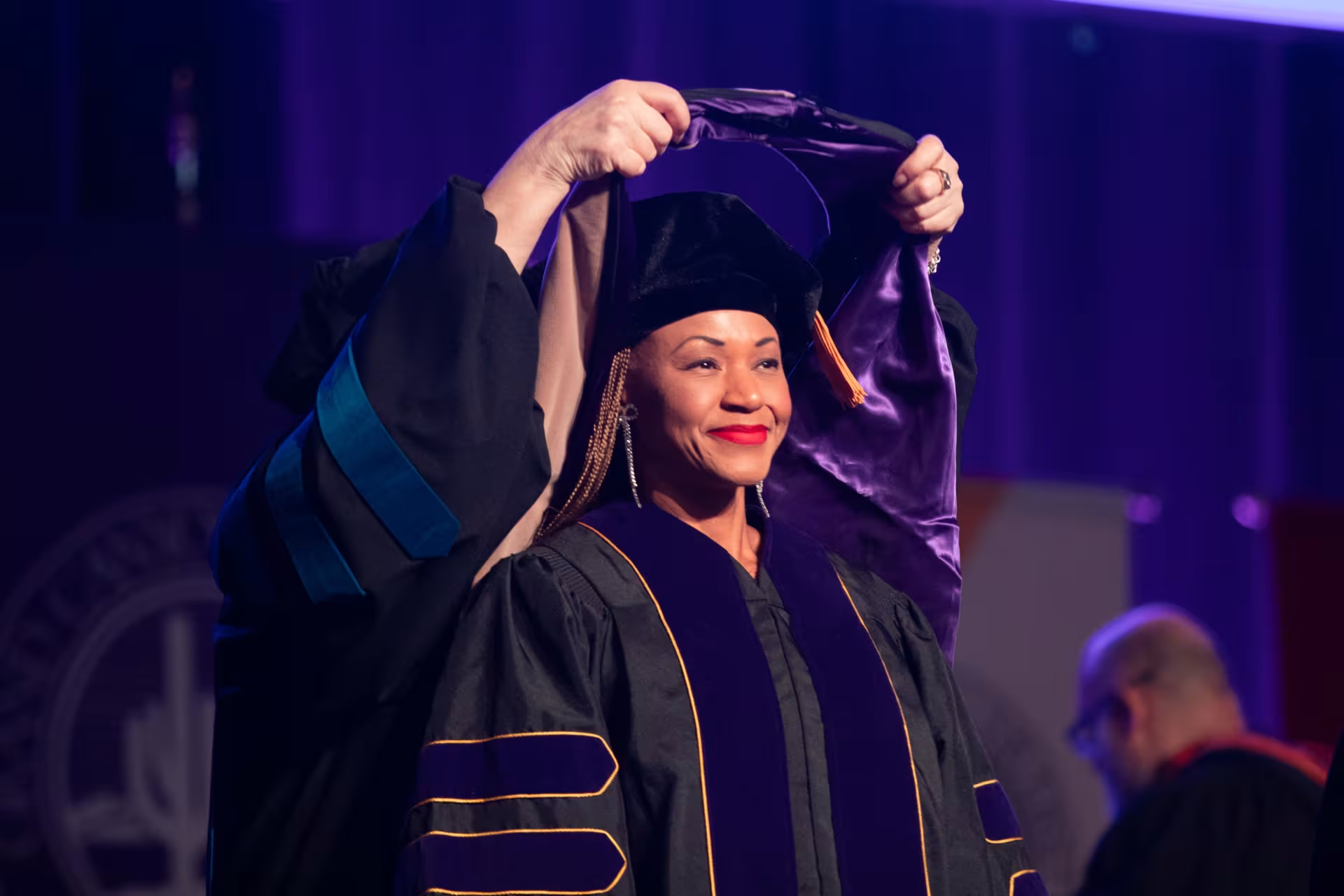
If you are ready to prepare for teaching and supervising the next generation of counselors, fill out the form on this page to learn more about the counselor education and supervision degree program at GCU.
(See disclaimer §) MOU-Alumni 10451: The Alumni $5,000 Scholarship for Doctoral Programs is only valid for GCU alumni who enroll in a doctoral program. If you enroll in a doctoral program through any of our online offerings, GCU will provide you a $5,000 tuition scholarship. This tuition scholarship will be applied on a per-course basis over your first and second academic year (as defined in the University Policy Handbook) and at the same time your tuition charges occur. This scholarship cannot be used in conjunction with any other GCU scholarships/awards. This credit will be applied toward your tuition only and you will not receive funds in excess of your charges.
- The earnings referenced were reported by the U.S. Bureau of Labor Statistics (BLS), Substance Abuse, Behavioral Disorder and Mental Health Counselors as of September 2023, retrieved on Sept. 29, 2023. Due to COVID-19, data from 2020 to 2022 may be atypical compared to prior years. BLS calculates the median using salaries of workers nationwide with varying levels of education and experience. It does not reflect the earnings of GCU graduates as Substance Abuse, Behavioral Disorder and Mental Health Counselors, nor does it reflect the earnings of workers in one city or region of the country or a typical entry-level salary. Median income is the statistical midpoint for the range of salaries in a specific occupation. It represents what you would earn if you were paid more money than half the workers in an occupation, and less than half the workers in an occupation. It may give you a basis to estimate what you might earn at some point if you enter this career. Grand Canyon University can make no guarantees on individual graduates’ salaries. Your employability will be determined by numerous factors over which GCU has no control, such as the employer the graduate chooses to apply to, the graduate’s experience level, individual characteristics, skills, etc. against a pool of candidates.
- U.S. Bureau of Labor Statistics. (2022, October 24). How To Become a Substance Abuse, Behavioral Disorder, or Mental Health Counselor. Occupational Outlook Handbook. Retrieved September 12, 2023.
- U.S. Bureau of Labor Statistics. (2023, September 6). How To Become a Postsecondary Teacher. Occupational Outlook Handbook. Retrieved September 12, 2023.
- The earnings referenced were reported by the U.S. Bureau of Labor Statistics (BLS), Postsecondary Teachers as of September 2023, retrieved on September 29, 2023. Due to COVID-19, data from 2020 to 2022 may be atypical compared to prior years. BLS calculates the median using salaries of workers nationwide with varying levels of education and experience. It does not reflect the earnings of GCU graduates as Postsecondary Teachers, nor does it reflect the earnings of workers in one city or region of the country or a typical entry-level salary. Median income is the statistical midpoint for the range of salaries in a specific occupation. It represents what you would earn if you were paid more money than half the workers in an occupation, and less than half the workers in an occupation. It may give you a basis to estimate what you might earn at some point if you enter this career. Grand Canyon University can make no guarantees on individual graduates’ salaries. Your employability will be determined by numerous factors over which GCU has no control, such as the employer the graduate chooses to apply to, the graduate’s experience level, individual characteristics, skills, etc. against a pool of candidates.